“…Japan is different. Everything works in Japan. In a Tokyo train station, you can stand at a marked spot on the platform and when the train stops, the doors will open right in front of you. Trains are on time. Bags are not lost. Connections are not missed. Deadlines are met. Things happen as planned. The Japanese are educated, prepared, and motivated.”
The above is an excerpt from Michael Crichton’s novel – Rising Sun. The hope is, that one day, India too becomes such a well-planned society like Japan, especially in the area of public transport.
Buses account for 90% of public transport in Indian cities. There are about 1,50,000 publicly owned buses in India.
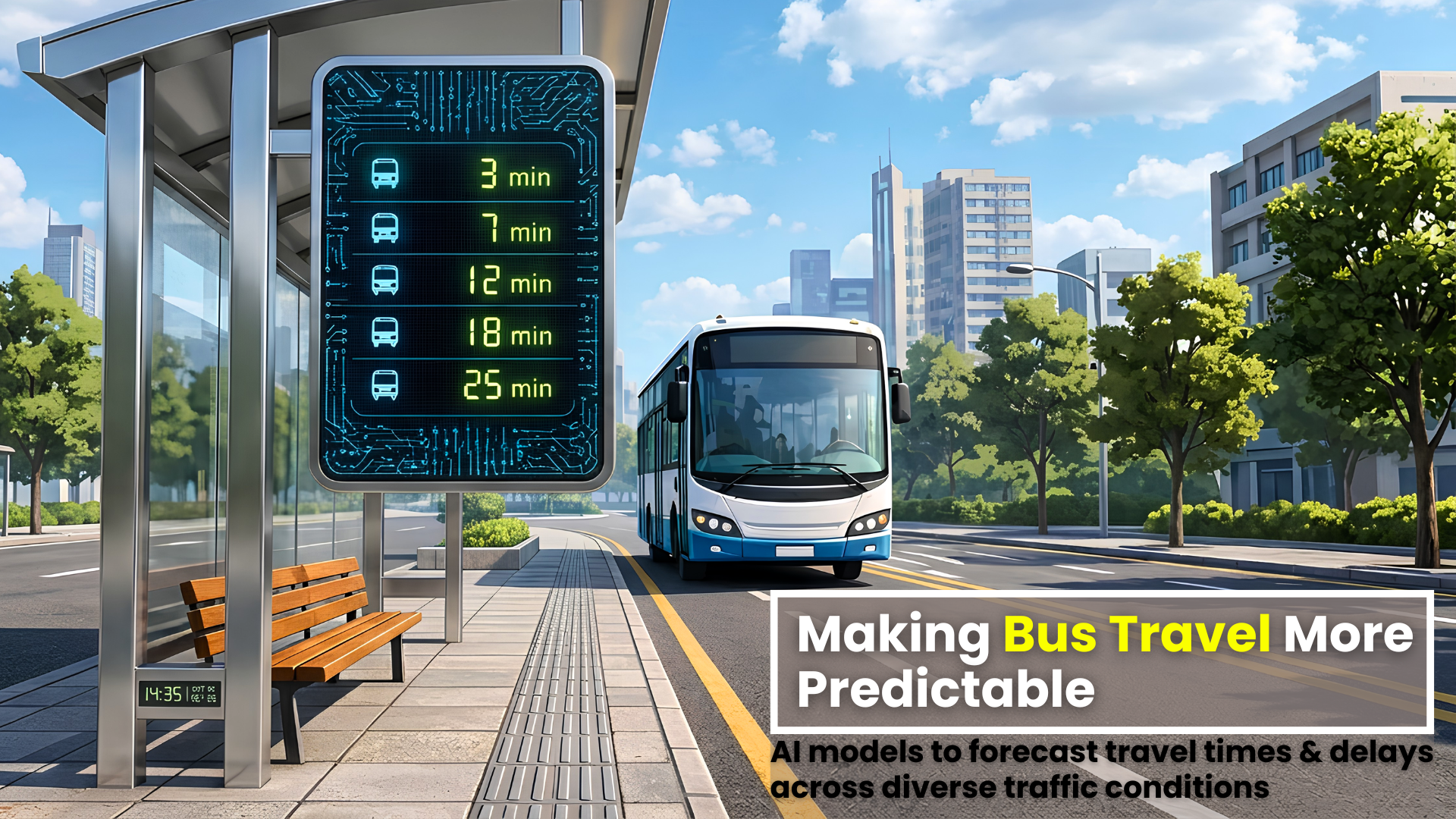
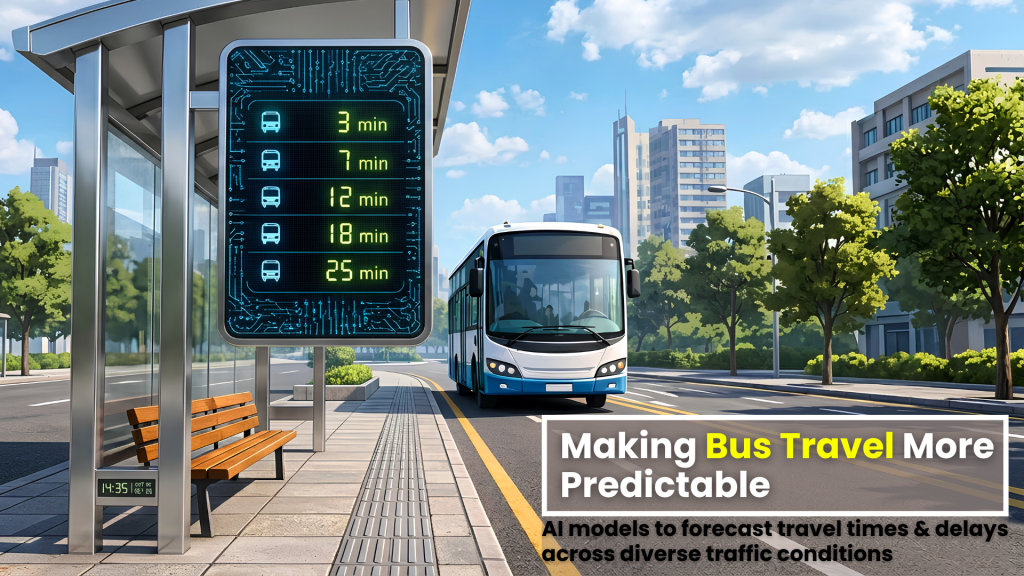
Accurately predicting the speed and travel time of public transport buses is crucial for ensuring the reliability of transit systems. Providing passengers with precise arrival times not only reduces waiting periods but also enhances commuter satisfaction and promotes greater public transport adoption.
But, forecasting bus travel times remains a challenging problem because of the variability in traffic conditions, road infrastructure, congestion, and weather.
Traditionally, statistical approaches were done to solve the bus travel time prediction (BTTP) problem in India. But statistics rely on predefined assumptions and often struggle to capture the complex, non-linear patterns present in real-world traffic conditions. Data-driven deep learning models (ANN, LSTM etc.) were explored next, which helped in improved accuracy. However, their “black-box” nature limited interpretability and real-world trust.
To balance accuracy and interpretability in BTTP, hybrid models integrating machine learning (ML) with domain-specific knowledge, have emerged as a promising solution.
Physics-Informed Machine Learning (PIML) is a rapidly evolving approach. The integration of first-principles knowledge with data-driven learning improves both predictive accuracy and interpretability by enforcing physically consistent constraints during the training process.
A Physics-Informed Neural Network (PINN) was employed, which embeds the physics-based equation as a constraint within the learning process. This integration enforces physically meaningful relationships, ensuring that predictions adhere to fundamental traffic dynamics. Another PIML method, the Physics-Informed LSTM (Phy-LSTM) was also developed.
To comprehensively assess these PIML solutions, a rigorous comparison was conducted against several alternative modelling paradigms. These included a traditional physics-based Aw-Rascle model solved using Godunov numerical scheme, purely data-driven architectures like artificial neural networks (ANN), and long-short-term memory (LSTM) networks.
Phy-LSTM was found to be more “generalist” among all of them, showing that it can be used to predict bus travel times under normal/off-peak conditions, but it does not take into account the high-magnitude travel time peaks.
High-magnitude travel time peaks constitute less than 1.8% of the training data, causing the models to treat them as “noise” rather than a critical pattern to be modelled. A temporal state-transition analysis revealed that if a section experiences a peak on one trip, the probability of a peak recurring at the same section on the very next trip is ~25.9%. This persistence makes a previous-trip-based trigger scientifically valid.
Therefore, a “specialist” model was added. XGBoost was selected as the best specialist among several candidates tested (ANN, Random Forest, Exponential Moving Average). Thus, a novel, two-stage “Generalist-Specialist” framework that solves the critical “peak prediction problem” was introduced for the first time by the authors of this paper. The temporally-informed switching logic uses Phy-LSTM for all sections except the peak sections with travel time greater than a threshold value, identified from data, where the XGBoost specialist is used instead of Phy-LSTM.

The following are the authors of this paper:
- Mr. Atmadip Goswami from the Department of Civil Engineering, Indian Institute of Technology Madras, Chennai, India.
- Dr. Chayan Banerjee from the School of Electrical Engineering and Robotics, Queensland University of Technology, Brisbane, Australia.
- Prof. Dhivya Bharathi from the Centre for Transportation Systems (CTRANS), Indian Institute of Technology Roorkee, Roorkee, India.
- Prof. Lelitha Vanajakshi from the Department of Civil Engineering, Indian Institute of Technology Madras, Chennai, India.
Prof. Clinton Fookes, who is a Professor in Vision & Signal Processing, and is the Director of the SAIVT Lab (Signal Processing, Artificial Intelligence and Vision Technologies), at the Queensland University of Technology, Brisbane, Australia, lauded the efforts of the authors with the following comments: “What I appreciate about this paper is that it does the hard diagnostic work rather than simply adding another hybrid model to the literature. The authors first establish why physics-informed learning helps, and then have the honesty to identify where even their best model falls short, namely on the rare, high-magnitude delays that matter most to commuters. Their solution is elegant: rather than continually re-engineering the network, they exploit the observation that a peak on one trip tends to recur on the next, using it to invoke a specialist model only when needed and cutting the error on these extreme events by around 80%. The calibration diagnostics, threshold-sensitivity study, and randomised-switching ablations reflect a level of careful, transparent analysis that is often missing in applied deep learning, and it is what makes the result convincing.”
Article by Akshay Anantharaman
Click here for the original link to the paper