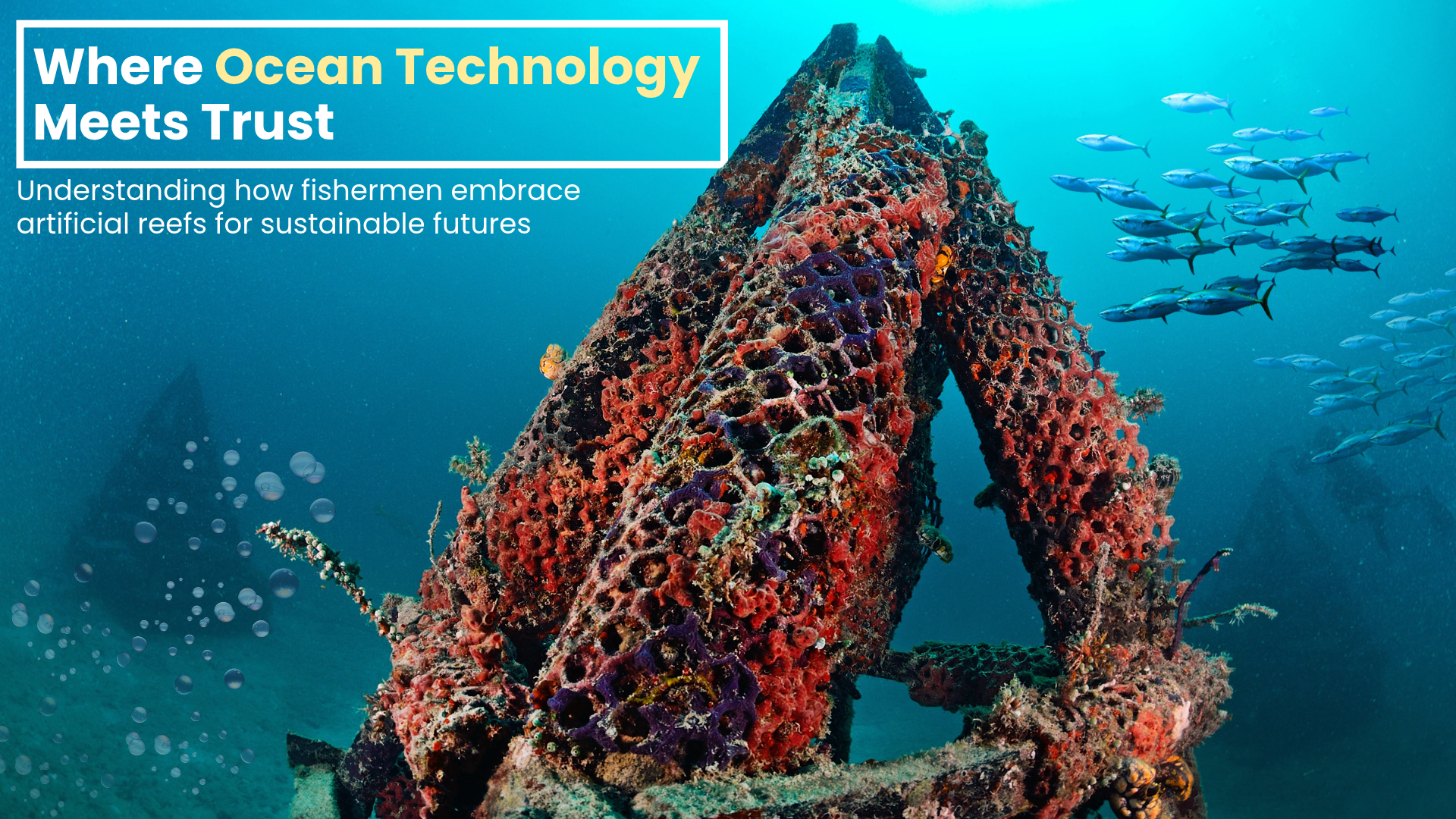
What’s a reef? Who’s a reef? Do you know what a reef is? Who knows what a reef is! This is exactly the attitude of fishers in Tamil Nadu towards Artificial Reefs (ARs).
What is a reef exactly? In the animated film, “Finding Nemo”, you may have seen a rock like structure where the clown fishes Marlin and Nemo reside. This is one type of reef, called a coral reef. A reef is basically a ridge or a large structure made up of rocks and other hard materials. It is usually found under water and provides a habitat for a variety of marine animals and plants.
Reefs serve many useful purposes besides providing a home for marine organisms. They support biodiversity, protect the coastlines, and support tourism, fishing, and local livelihoods.
Today, the world over, marine fisheries face mounting ecological and socio-economic pressures due to overexploitation, habitat degradation, and climate variability. In India, small-scale fishers are particularly vulnerable because of declining catches, habitat loss, and growing mechanization.
Here Artificial Reefs (ARs) have emerged as a potential solution to restore marine habitats, enhance fish biomass, and improve fish productivity.
Artificial Reefs, are human-made reefs, specially designed using concrete, steel, or other environmentally safe materials. ARs are made to attract more marine life, restore habitats, and support fisheries and tourism, as well as to support fishers’ livelihoods.
Despite these advantages, fishers in Tamil Nadu are reluctant to use ARs.
Most studies focus on ecological and biological outcomes rather than on the behavioural and socio-economic dimensions of adoption. Therefore, in this study, the authors, Prof. Krishna Malakar, Mr. Periyasamy Seenivasan, and Prof. Santosh Kumar Sahu from the Department of Humanities and Social Sciences, Indian Institute of Technology (IIT) Madras, Chennai, India (The authors are also affiliated with the School of Sustainability, IIT Madras, Chennai, India), have examined the behavioural intention of coastal fishers to adopt ARs, integrating ecological and contextual dimensions.
For this study, the researchers have utilized the technology adoption theory called the Unified Theory of Acceptance and Use of Technology (UTAUT). This provides a well-established framework for analysing user behaviour toward technologies. This framework has been successfully applied across sectors such as AI, banking, cybersecurity, and healthcare.
The findings revealed that trust in technology, environmental compatibility, and facilitating conditions were the most influential and statistically significant predictors of adoption, highlighting the importance of institutional credibility, ecological alignment, and supportive infrastructure in driving positive behavioural responses.
However, perceived risk exerted a small yet significant negative effect, indicating that environmental uncertainties and potential ecological concerns continue to temper adoption.
AR adoption remains driven more by collective trust and perceived ecological fit than by individual utility or experiential satisfaction.
Given the strong influence of trust in technology and facilitating conditions, fisheries departments should strengthen extension support, stakeholder consultations, and participatory monitoring with local fishing communities.
Greater involvement of fishers in reef site selection and post-deployment evaluation can further enhance institutional trust, transparency, and long-term stewardship of resources, thereby supporting sustained adoption and effective utilisation of AR interventions.
Ultimately, the findings suggest that strengthening behavioural uptake of ARs can enhance the effectiveness of sustainability-oriented fisheries interventions, thereby contributing to improved marine ecosystem health and livelihood security in coastal communities, consistent with implications for blue economy objectives and aligning with the Sustainable Development Goals (SDGs) – SDG 14 (Life Below Water) and SDG 8 (Decent Work and Economic Growth).

Dr. Debashis Acharya, who is a Professor at the School of Economics, University of Hyderabad, Hyderabad, Telangana, India, acknowledged the importance of the work done by the authors with the following comments: “The paper makes a major contribution by successfully extending the Unified Theory of Acceptance and Use of Technology (UTAUT) to evaluate state-mediated, collective ecological infrastructure in small-scale fisheries. Methodologically, the study displays empirical rigour, leveraging a well-sampled primary dataset of 442 coastal fishers in Tamil Nadu analyzed through Partial Least Squares Structural Equation Modeling (PLS-SEM) with high explanatory power. The key takeaway is that trust in technology, environmental compatibility, and institutional facilitating conditions act as the primary drivers of community adoption, proving that institutional credibility matters more than individual operational ease in collective contexts. By incorporating perceived risk and voluntariness of use, it adds immense value with its socio-ecological analysis. Finally, the work is highly relevant for policy making in light of the state initiatives like the Pradhan Mantri Matsya Sampada Yojana (PMMSY), connecting well localized community restoration to broader Sustainable Development Goals (SDG 8 and SDG 14).”
Article by Akshay Anantharaman
Click here for the original link to the paper