The discovery of new medicines/drugs, for diseases like cancer, goes through five stages, including preclinical research, clinical research, regulatory review and approval, etc. It is a tedious process, and a new medicine/drug is passed only after 10 to 15 years.
Initially, researchers have to find a disease target, and test thousands of chemical compounds to find a promising “hit”. Tedious as this process may be, there are motifs, or recurring structures or features that have important functional value.
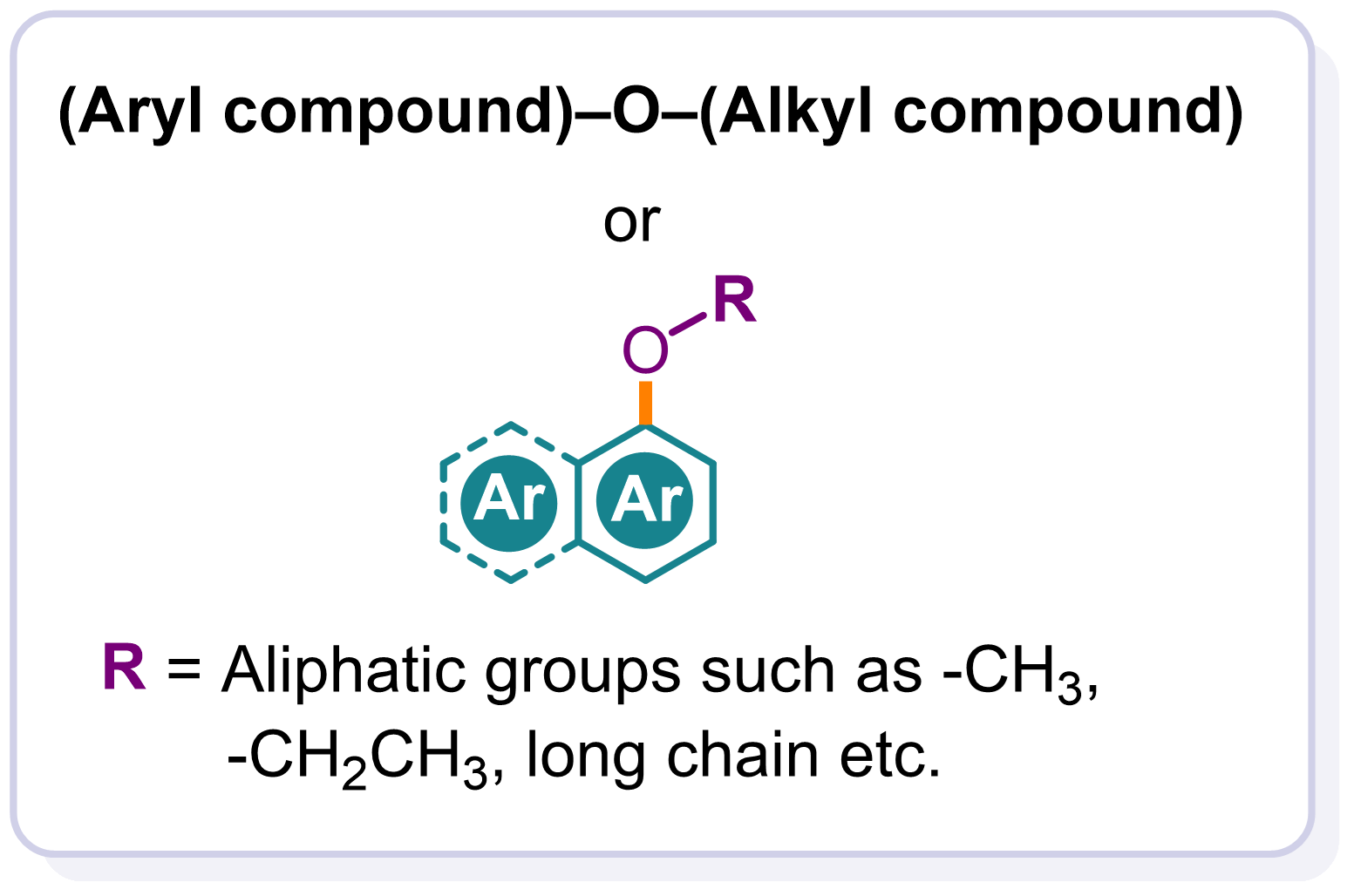
One of these motifs is known as aryl alkyl ethers. An aryl compound is represented by a ring structure, such as benzyl, or with a molecular formula C6H5-.
An alkyl compound is represented by a methyl structure, such as, CH3-, CH3CH2-, etc.
In aryl alkyl ethers, the aryl compound, and the alkyl compound are connected to a common oxygen (O) atom.
Therefore, the basic structure of an aryl alkyl ether is given by:
Aryl alkyl ethers are structurally and functionally important motif compounds, found in natural products, pharmaceuticals, agrochemicals, and in functional materials. They frequently act as key phramacophores and molecular linkers, influencing conformation, lipophilicity, and target binding affinity. Because of their various functions, they are in great demand.
Among the existing approaches, transition metal-catalyzed cross-coupling between aryl halides and alcohols has become the most versatile strategy. Catalysts based on palladium, nickel, gold, and copper have thus enabled diverse C(sp2) – O bond formations [sp2 refers to the orbital hybridization of a molecule which determines its structure]. However, these methods typically rely on activated electrophiles (iodides, bromides) [electrophiles are chemicals that accept electrons] and often require high temperatures and specialized ligands [a ligand is an electron-pair donor that binds to a central metal atom or ion]. Therefore, extending these transformations to inert electrophiles remains a persistent challenge.
In this context, fluorine-containing compounds have gained extraordinary importance in modern molecular design as incorporation of fluorine atoms can dramatically alter acidity, lipophilicity, metabolic stability, and binding selectivity.
Even though there is an abundance of fluoroarenes, their use as electrophiles in cross-coupling chemistry remains largely untapped. The C–F bond is exceptionally strong, and has kinetic inertness, which makes aryl fluorides resistant to oxidative addition and nucleophilic activation.
Here, alcohols present a solution. Alcohols are abundant, readily available from lignocellulosic biomass and various industrial processes, thus gaining importance for their sustainable nature.
But combining aryl fluorides and alcohols remains a challenge because of their unreactiveness making C(sp2)–O bond formation really challenging.
Reported approaches to C(sp2)–O bond formation from aryl fluorides and alcohols depend on harsh conditions such as high temperatures, extended reaction times, and dehydrating agents. There is need for a general, mild, and sustainable strategy for C(sp2)–O bond formation from aryl fluorides and alcohols.
The answer to this problem lies in what are known as radical-mediated pathways. A radical is a molecule or atom that has an unpaired electron.
Example: Chlorine radical is given by Cl·, where · represents the unpaired electron
Radical-mediated pathways follow a sequence of reactions involving radicals.
However, these methods require excess alcohol, or excess aryl fluorides and exhibit a limited substrate scope. Also, secondary aliphatic alcohols afforded the corresponding products in notably lower yields. Therefore, effective atom-economic protocols that work for all alcohol variants under mild conditions are required.
A redox-active ligand framework combined with an earth-abundant 3d metal represents an attractive avenue. Zinc (Zn) is abundantly available, has low toxicity, and Lewis acidity.
Therefore, in this study, the authors Mr. Subarna Manna, Ms. Navya Shenny Kavil, and Prof. Arnab Rit from the Department of Chemistry, Indian Institute of Technology (IIT) Madras, Chennai, India, have, for the first time focused on Zn(II)-amide framework – catalyzed diverse C(sp2)–O bond formation between aryl fluorides and alcohols under mild conditions.
Overall, this work establishes a mechanistically distinct, operationally simple, and sustainable platform for selective aryl C–F bond functionalization that expands the toolbox of C–O bond generation.

Dr. Nanda Dulal Paul, an Associate Professor from the Department of Chemistry and Associate Dean – Research, Indian Institute of Engineering Science and Technology (IIEST), Shibpur, Howrah, West Bengal, India acknowledged the significance of the work done by the researchers, and pointed out the important points of their research with the following comments: “This research article represents a significant and impactful contribution to sustainable synthetic chemistry. The development of a zinc-based catalytic system for selective C(sp2)–O cross-coupling of inert aryl fluorides with diverse alcohols is particularly noteworthy, as it addresses the longstanding challenge of C–F bond activation under relatively mild conditions. The broad substrate scope, excellent chemoselectivity, detailed mechanistic investigations, and applicability to biologically relevant molecules together demonstrate both the originality and practical importance of this work. Overall, the study elegantly illustrates how redox-active ligand design can harness earth-abundant metals to unlock new reactivity, and it is likely to inspire further progress in sustainable catalytic transformations.”
Article by Akshay Anantharaman
Click here for the original link to the paper