Fresh water is becoming more valuable than gold, diamonds, and all the valuables of the world put together! Although at least 70% of the earth is covered with water, only 2.5% of that water is potable, or usable for daily activities like drinking, cleaning, washing, and bathing. The rest of the water in water bodies is usually saline water. Therefore, effective desalination processes are in high demand nowadays.
Researchers from IIT Madras have already made headway in this cause. In a recent study, the authors of this paper, Dr. Thilagan K., Dr. Advaith S., and Prof. Mani A. from the Refrigeration and Air-conditioning Laboratory, Department of Mechanical Engineering, IIT Madras, Chennai, India, have developed a stand-alone solar multi-effect desalination (MED) system to convert sea water into potable water using solar energy. The studies were conducted at Vivekananda Kendra, Kanyakumari, India, drawing sea water from the Gulf of Mannar. For more details on this work, please refer to the following article:
https://tech-talk.iitm.ac.in/a-solar-multi-effect-desalination-success/
In the above study, the solar MED plant performances were studied using sea water during March 2019. The solar MED plant produced 7,000 litres of fresh water during this month. The distillate water quality was found to be in the range of 1 ppm to 3 ppm (ppm – parts per million). By integrating with the adequate capacity of the thermal storage system and increasing battery backup, the solar MED plant could operate for 24 hours at a higher production rate.
However, these commercial desalination systems require a large area for installation to produce fresh water. Also, the desalination techniques used here require a shell and tube type exchanger, which is not very effective.
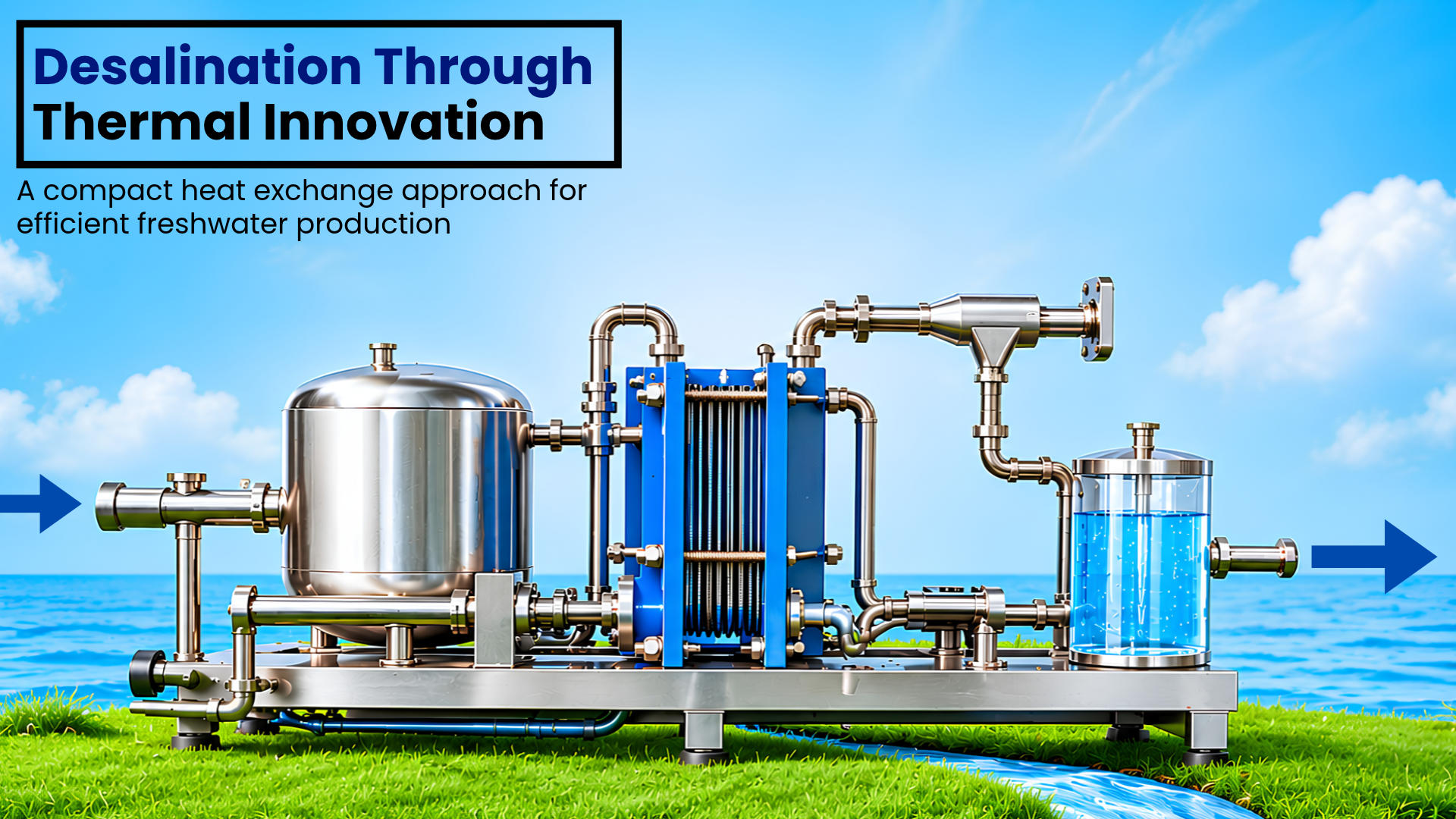
A gap in previous literature is that the system size needs to be reduced without compensation for the product efficiency, and lowering the cost per litre. Therefore, in this study, a compact desalination system (CDS) was designed and developed using gasketed plate heat exchangers (GPHX). The use of CDS with GPHX reduces investment costs and drastically lowers the cost per litre of water.
Plate type of heat exchangers are attracting more attention in industries like food, chemical, and pharmaceutical industries; heating and cooling systems; refrigeration and air-conditioning, because of their compact size, lesser weight, and easier maintenance when compared to conventional shell and tube exchangers.
The CDS used in this study comprised mainly a flash chamber, a GPHX, and an ejector. Steam is produced in the flash chamber by feeding hot water from a constant-temperature water bath. The steam then condenses on the GPHX hot side, releasing latent heat to cold water circulating on the cool side, which absorbs the heat to form distillate. The condensed distillate water is stored in the distillate tank and pumped back to the water bath. The same thing happens with brine water (saline water).
This study developed and evaluated a compact desalination system (CDS) with a capacity of 15 litres per hour, demonstrating significant advancements in energy-efficient, cost-effective fresh water production. The system achieved an average flashing efficiency of 79% in the flash chamber. The gasketed plate heat exchanger (GPHXcond) employed as the condenser for CDS outperformed the shell and tube heat exchangers by 30% to 40%.

The CDS used in this study also achieved 10% to 30% cost reduction compared to traditional systems. The system’s compatibility with solar energy supports sustainable operation (SDG 7) and addresses fresh water demand (SDG 6), with potential for enhanced coefficient of performance (COP) at higher production capacities. [SDG refers to the Sustainable Development Goals prescribed by the United Nations]
Future work could focus on experimental evaluation of a double-stage CDS system, investigation of modified GPHX surfaces for enhanced performance in double-stage systems, and full-scale experimental trials to optimise design capacity and system efficiency.
Prof. Alberto Coronas, who is a Full Professor at the Mechanical engineering Department of the University Rovira i Virgili, Catalonia, Spain, and founder and director of the research group of Applied Thermal Engineering-CREVER, gave the following observations on this study: “This article presents experimental research on a compact desalination system that produces 15 litres of distilled water per hour. The system uses innovative gasketed plate heat exchangers (GPHX) and ejectors to achieve 30-40% effectiveness improvements over traditional shell-and-tube designs while reducing investment costs by 10-30%. The researchers tested the system with both tank water and seawater, producing high-quality distillate with 10-15 ppm salinity through comprehensive experimental, thermodynamic, and economic analyses.”
Article by Akshay Anantharaman
Click here for the original link to the paper