If you can manage the traffic in India, you’ve managed the impossible!
With more and more vehicles coming up every day, managing traffic is a huge task. The diversity in vehicle types, coupled with a unique driving culture, manifests as complex interactions and maneuvers, resulting in congestion that is challenging to manage.
Initially, homogeneous traffic used to be considered, where vehicles follow predictable patterns within designated lanes. But this is not realistic in the Indian context. Therefore, mixed traffic has been the way forward, where a diverse range of vehicles, including cars, motorcycles, buses, and trucks, operate without strict lane discipline.
Traditionally, various models have been considered to study how to model and manage mixed traffic, such as the PCU-based approaches, multi-class traffic models, etc. The PCU, or the Passenger Car Unit – based approaches, convert different vehicle types into equivalent passenger car units to standardize heterogeneous vehicle classes into a homogeneous framework. These models have been well known for their drawbacks, such as oversimplified vehicle interactions, speed estimation challenges, neglect of direct interactions between different vehicle classes, etc.
To overcome the limitations of the PCU model, multi-class traffic models seemed to be the answer. Here, traffic is categorized into distinct vehicle classes rather than homogenizing them into a single equivalent unit. But these methods too faced challenges in defining class-wise regimes, identifying state transitions, maintaining traffic conservation properties, etc., especially when dealing with more than two vehicle classes.
In the case of two-dimensional LWR-type models, (LWR model is a mathematical model to describe traffic flow on roads) and geometry-dependent conservation models which incorporate lateral diffusion (the tendency of vehicles to spread sideways), boundary repulsion (refers to the natural tendency of drivers to steer away from the edges of the road), and spatially varying flux directions (refers to how the volume and direction of moving vehicles change across different physical locations within a road network), were considered. But here too, it is difficult to explain lateral diffusion for traffic flow.
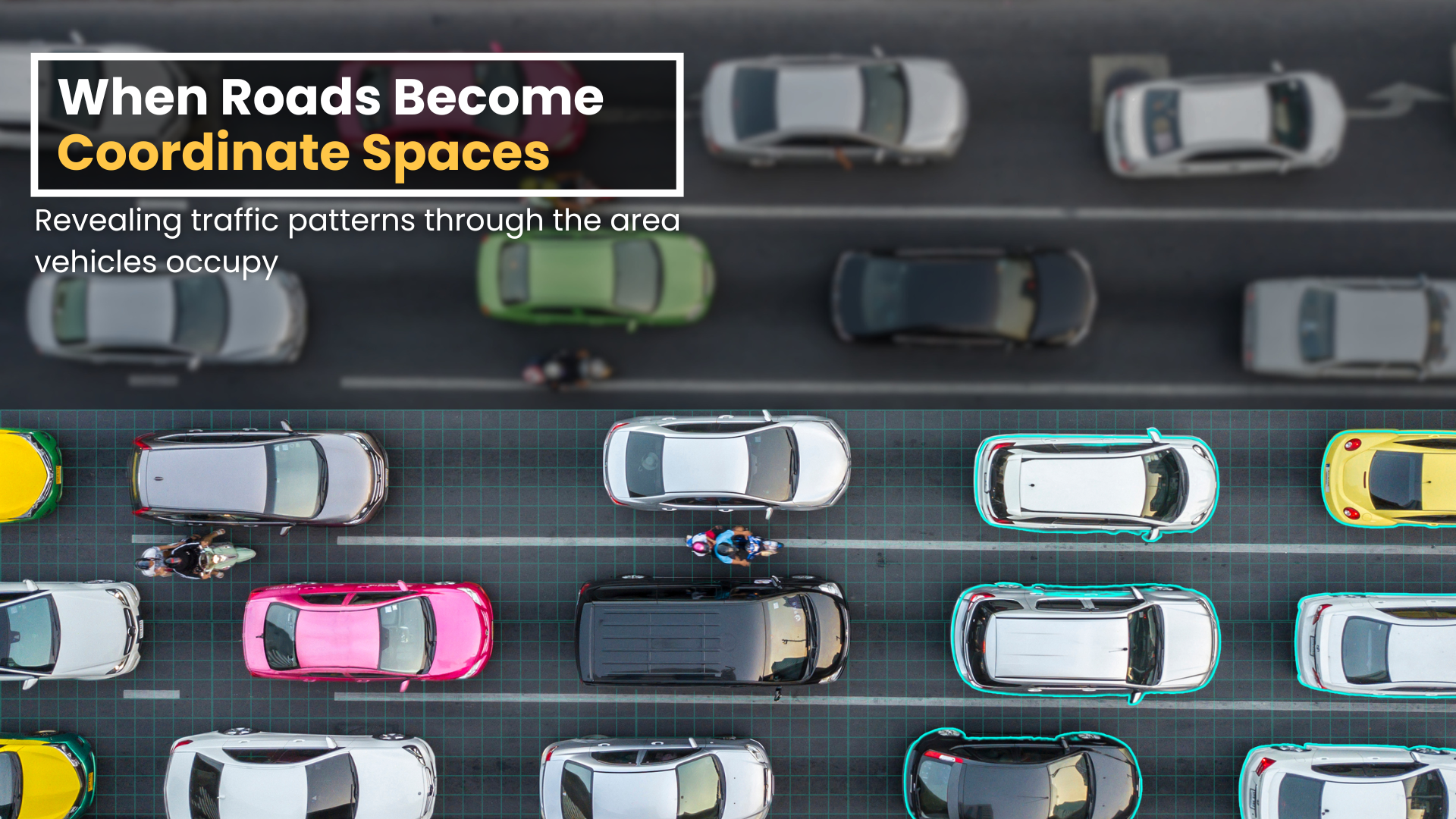
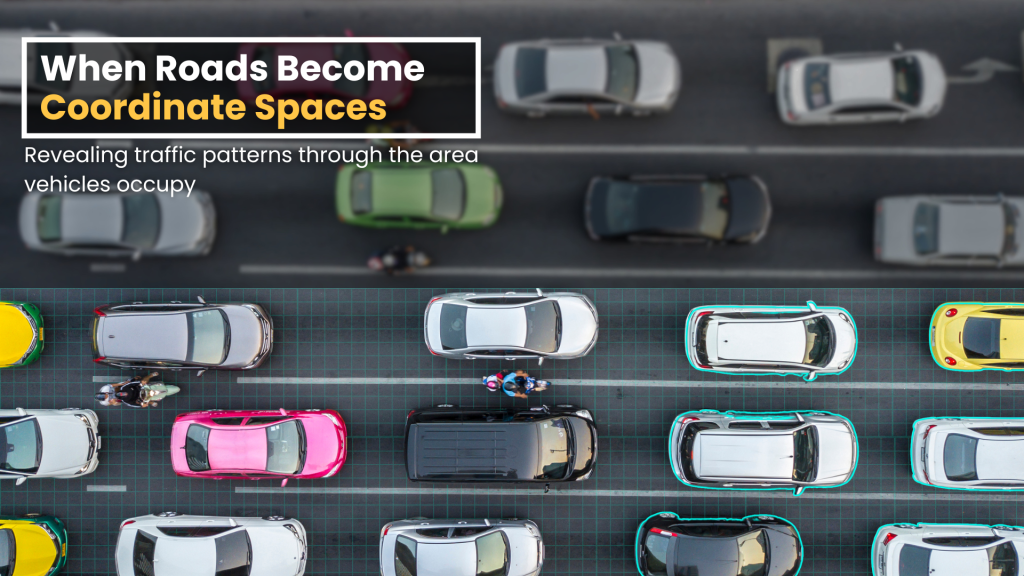
Therefore, to address these limitations, researchers have proposed area-based measures, which account for the physical space occupied by vehicles, rather than the number of vehicles, which can be easily conserved under all conditions.
But area-based measures have the following limitations:
- Some models consider only vehicle width, neglecting vehicle length, which leads to errors in estimating flow and congestion levels.
- Others attempt to convert area occupancy into equivalent density using only vehicle length, which may distort the representation of traffic dynamics.
These issues highlight the need for better representative traffic variables for mixed traffic conditions and a comprehensive continuum (a continuum in traffic flow treats traffic as a continuous fluid) modelling framework that properly conserves vehicle area rather than vehicle count.
The surprising thing is, till now, no efforts have been made to develop a continuum model based on the concept of vehicle area conservation!
Therefore, in this study, the authors Dr. Nandan Maiti from the Department of Civil Engineering, Indian Institute of Technology Kharagpur (IITK), Kharagpur, India, and Dr. Bhargava Rama Chilukuri from the Department of Civil Engineering, Indian Institute of Technology Madras (IITM), Chennai, India, have proposed an areal continuum model which focuses on vehicle area rather than vehicle number.
In this study, two new traffic variables – areal density and areal flow were introduced. Areal density refers to the proportion of space occupied by vehicles. Areal flow refers to the spatial flow of vehicle area.
The model was validated using empirical data from high-resolution trajectory data from three Indian cities.
Thus, a continuum model for mixed traffic was developed based on the principle of vehicle-area conservation. Furthermore, flux functions based on areal density and areal flow were developed, providing the foundation for the numerical solution methodology proposed for the areal continuum model. Numerical simulations demonstrate that the proposed model realistically captures the merging and vehicle dispersion phenomena observed in mixed traffic streams.
While the empirical analysis offers valuable insights, further research is needed to validate and generalize these findings across various traffic conditions and geographical contexts. Future studies could investigate potential applications of the proposed multi-class model for various scenarios.

Prof. Danjue Chen, Associate Professor in the Department of Civil, Construction and Environmental Engineering at North Carolina State University, Raleigh, North Carolina, United States, found this research interesting and acknowledged its significance with the following comments: “This paper introduced a fresh and unique perspective to model traffic flow, the vehicle area, which addressed the challenges of modeling heterogeneous and/or lane-free traffic. This perspective provides a more general lens to understand and quantify traffic flow and I found it very interesting. A new macroscopic model, the Areal Continuum Model was developed and validated against empirical data. The new model has enabled more accurate and adaptable analysis of traffic flow and potential traffic management strategies. I look forward to seeing further development or applications of the model. ”
Article by Akshay Anantharaman
Click here for the original link to the paper