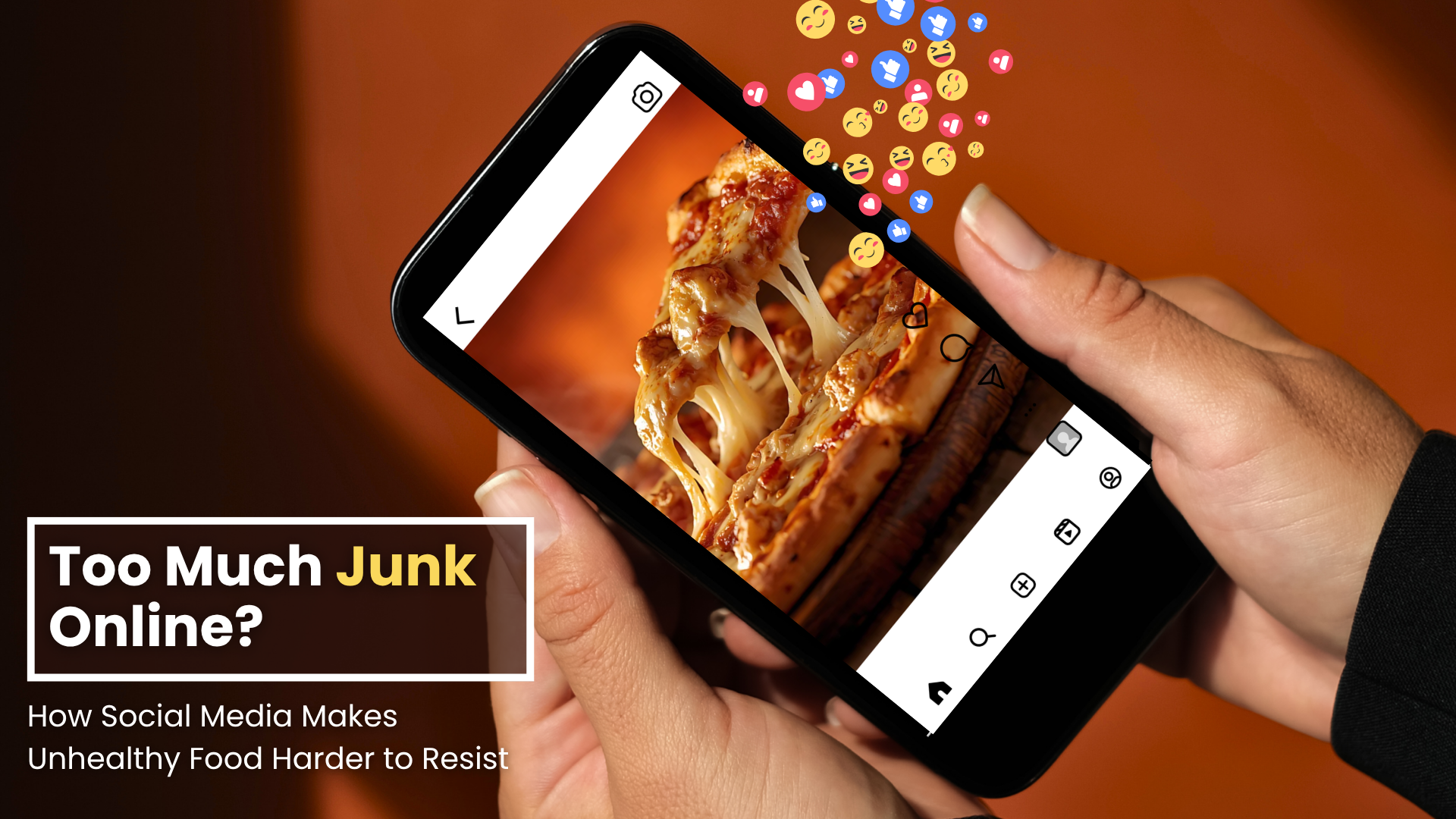
If I laid a medium double cheese pizza, and a packet of bitter gourd chips in front of you, which are you more likely to choose? It doesn’t matter how much I try to divert your attention towards the bitter gourd chips, you immediately go for the greasy, cheesy pizza!
Food advertising has conditioned us to go for three tastes – sugar, salt, and fat, which are all unhealthy. Fifty years ago, these flavours were available in meagre quantities, but now, there is an abundance of these food items.
The abundance of junk food, which is readily available, has unfortunately led to the obesity epidemic all over the world. One in eight people is affected by obesity today in the world. Obesity can lead to many ailments such as heart disease, cancer, and diabetes, which are all harmful, and possibly, fatal.
Advertising has always been done in many ways – through newspapers, radio, billboards, etc. But with the recent advent of social media platforms like Twitter, Facebook, Instagram, YouTube, etc. going “viral” seems to be the motive for all advertisers.
Of course, in this race for likes, comments, and shares, unhealthy food advertising has not been left behind. There is advertising for healthy food on social media as well, but users are more likely to like, comment on, and share unhealthy foods on social media.
This is because social media ranking algorithms prefer content with more engagement, which is found more for unhealthy foods that are advertised. Unhealthy food advertising emphasizes taste and sensory experiences, which aim to elicit emotional responses, while, healthy brands focus on sterile nutrition education, which is rarely effective in capturing attention and persuading audiences.
There are two types of content on social media – user-generated content (UGC) and marketer-generated content (MGC).
UGC refers to content created by real people and customers. MGC refers to content shared directly by a company or brand. Although there has been some research done with respect to UGC, MGC has been explored less, in the context of food advertising.

Therefore, in this study, the authors Ms. Christy Maria TS and Dr. Varisha Rehman from the Department of Management Studies, Indian Institute of Technology (IIT) Madras, Chennai, India, have used an AutoML image classification model on Google Cloud Vertex AI to classify the MGC of food brands on Instagram and Twitter to compare and analyse the MGC of healthy and unhealthy food brands, and to understand the interplay of brand, content, and platform on user engagement.
To understand consumer engagement with social media content, the Heuristic-Systematic Model (HSM) and Media Richness Theory (MRT) were considered. HSM posits two processing routes – systematic, involving analytical evaluation of details such as product features, and heuristic, relying on simple cues like visuals or emotions.
Complementing this, MRT emphasizes how platform richness influences engagement. Richer platforms encourage heuristic reactions through visually appealing content, whereas lower-richness platforms foster more systematic responses to text-based information.
In this study, both HSM and MRT work in tandem, a combination that remains underexplored in current literature. This combination offers a novel lens for analysing how different types of content [transactional (product/brand specific) and non-transactional (general others)] perform across various brands (healthy and unhealthy) and social media platforms (Instagram and Twitter).
This study also provides implications for healthy food brands, producers, consumers, and society with relevance to United Nations Sustainable Development Goal 3 (SDG3 – Ensure healthy lives and promote well-being for all at all ages). According to the results, unhealthy brands adopt platform-specific content strategies, emphasizing non-transactional content on Instagram and transactional content on Twitter, whereas healthy brands employ a similar transactional strategy across both platforms.
The findings imply that by incorporating appealing non-transactional content and implementing more dynamic, platform-specific strategies, healthy brands can increase engagement. Making healthy food attractive on social media may empower consumers to choose healthier options and lessen the perceived trade-off between taste and health.
Prof. Arti Kalro, who is Professor (Marketing) & Associate Head, Shailesh J. Mehta School of Management, Indian Institute of Technology (IIT) Bombay, Mumbai, India, pointed out the important points of this study with the following appreciative comments: “Analysing content strategies of healthy vs. unhealthy food brands on social media using machine learning: a comparative study across platforms: This research’s findings exhibit strong ecological validity, as it involves the analysis of a large, real-world dataset of 21,967 Instagram and Twitter posts. The methodology adopted is robust, as the authors combine manual coding, AutoML, MANCOVA, and gradient boosting with the classification model that achieved a 0.92 AuPRC and 98% validation accuracy. One of the key theoretical contributions involves the integration of Media Richness Theory and the Heuristic–Systematic Model. The strong theoretical grounding helped in understanding why visual, entertaining content works better on Instagram while information-led content can lead to higher engagement on Twitter. Another key finding is that unhealthy brands use more engaging, non-transactional content. However, healthy brands still rely on factual and product-focused posts. This helps in explaining the gap in engagement between them. The managerial implications are very practical: healthy food brands do not need to reduce health information but should present it through better storytelling, entertainment, attractive visuals, and platform-specific content to compete more effectively for attention.”
Article by Akshay Anantharaman
Click here for the original link to the paper