It is now a well-known fact that quantum computers are so powerful, that they take minutes to solve a complex calculation that would take a supercomputer billions of years to solve! Add to this, the development of quantum chips by Google (Willow) and Microsoft (Majorana 1), means that we’re going to be in for a very special time very soon! Even sooner is the possibility of a quantum simulator – as the famous physicist Richard Feynman envisioned in 1981.
Feynman observed that as a quantum system increases in size, the computational resources needed to simulate it on a classical computer grown exponentially. He proposed a “quantum simulator”—a device that uses quantum mechanical principles to simulate other quantum systems. Feynman stated, “Nature isn’t classical, dammit, and if you want to make a simulation of Nature, you’d better make it quantum mechanical”.
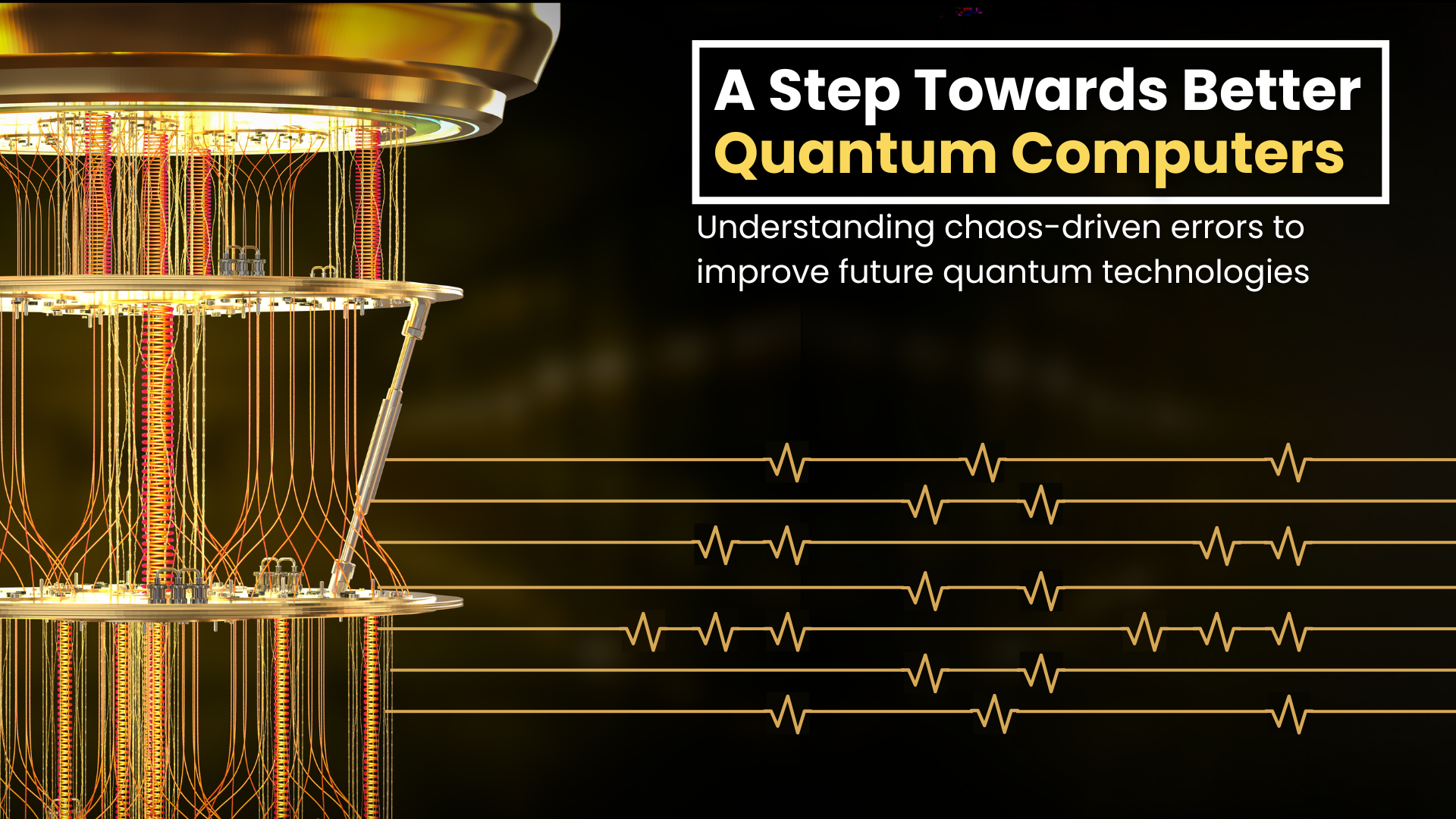
The current quantum computers are NISQ (Noisy Intermediate-Scale Quantum) devices. As the name suggests, these computers are noisy, of an intermediate-scale, and more prone to errors. Quantum computers and simulators such as NISQ devices, are prone to errors and disturbances because they are very sensitive to their external environment. These disturbances include heat, electromagnetic interferences, vibrations, etc., and are collectively called noise. Noise is one of the biggest challenges in quantum computing. With the current knowledge of quantum mechanics, there is a possibility of building quantum simulators, thus getting closer to the dream of achieving the holy grail of quantum computing – a many-body quantum computer. However, the same properties that make quantum systems generate complexity will make them sensitive to errors. This is more so as any complex information processing of interest, computation or simulation, is intimately connected to the concept of chaos.
Chaos in classical physics refers to extreme sensitivity to initial conditions (like predicting the weather). How does chaos manifest at the quantum level is an open and contentious question. In this study, the authors Dr. Abinash Sahu, Dr. Naga Dileep Varikuti, and Prof. Vaibhav Madhok from the Department of Physics, Indian Institute of Technology (IIT) Madras, Chennai, India, and Center for Quantum Information, Communications and Computing, IIT Madras, Chennai, India (Mr. Naga Dileep Varikuti is also affiliated with Pitaevskii BEC Center, CNR-INO and Department of Physics, University of Trento, Via Sommarive, Trento Italy; and INFN-TIFPA, Trento Institute for Fundamental Physics and Applications, Via Sommarive, Trento, Italy), study footprint of chaos in the quantum world as well as its consequences to quantum simulation of many-body Hamiltonians under the influence of systematic errors. In this study, a signature of chaos was identified, that is intimately connected with the very notion of chaos – randomness, errors, predictability, and information. This work paves the way for further studies in the performance of quantum simulators under inadvertent noise.
In particular, they address the following questions:
- How does chaos lead to rapid scrambling of information as well as systematic errors across a system when one introduces perturbations in the dynamics?
- What are its consequences for the reliability of quantum simulations and quantum information processing?
- What happens to the information gain in the presence of systematic errors?
Two quantifiers of quantum chaos are looked into here, namely, the Loschmidt echo (LE), and the Out-of-Time-Ordered correlators (OTOCs).
In quantum mechanics, chaos leads to amplification of noise, in the form of systematic errors and scrambling of information, when one introduces perturbations in the dynamics. Out-of-Time-Ordered correlators (OTOCs) measure how quickly information spreads through a quantum system. They capture the operator growth and scrambling of quantum information and have been very useful as a probe for chaos in quantum systems.
A quantum echo is the reappearance or recovery of a quantum signal after it becomes decayed or scrambled. It is similar to an echo in the mountains – a sound spreads out and fades, but is later returned. A Loschmidt echo is an echo that measures how sensitive a quantum system is to small disturbances or imperfections.
The two quantifiers of quantum chaos, namely, LE and error OTOC are connected through continuous weak measurement tomography (quantum tomography refers to a method used to determine the complete state of a system by making many measurements on identical copies of that system).
The approach used here shows that besides establishing a link between LE and scrambling of errors as captured by error OTOCs, it can be tested in the laboratory. Experimentally, it is a huge challenge to measure information scrambling. The proposal in this research to study chaos and scrambling using continuous measurement tomography, needs only single-shot forward evolutions of the system with simple modification to the existing experiments.
Prof. Adolfo DEL CAMPO ECHEVARRIA, Full Professor in theoretical condensed matter physics at the University of Luxembourg, Luxembourg, appreciated the work done by the authors, and their approach, with the following comments: “Madhok’s team at IIT Madras probes the interplay of quantum chaos, complexity, and information theory under the lens of continuous measurement tomography. They reveal how errors spread and grow over time and provide experimentalists with a means to characterize this growth by introducing a novel tool: the “error OTOC”. This fresh approach is directly relevant to a diverse range of scenarios from black hole physics to quantum simulation and computing with NISQ devices. It also challenges the assumption of local errors that underpins much of fault-tolerant computing.”
Article by Akshay Anantharaman
Click here for the original link to the paper