‘I, Robot’ was a sci-fi movie released in 2004 that starred Will Smith. It was one of those clichéd films that showed robots gaining sentience and turning hostile towards human beings. (of course, there was a happy ending in this film!)
But as of today, robots are more user-friendly and they actually help people rather than harm them. They are used in manufacturing and automobile industries to do work that no human can do. They are also used to perform various specialised tasks, such as minimally invasive surgeries in hospitals, to docking of spacecrafts and manipulating the mirrors on the James Webb telescope. These were crucial in creating the realistic boat motions in the award-winning movie ‘Life of Pi’.
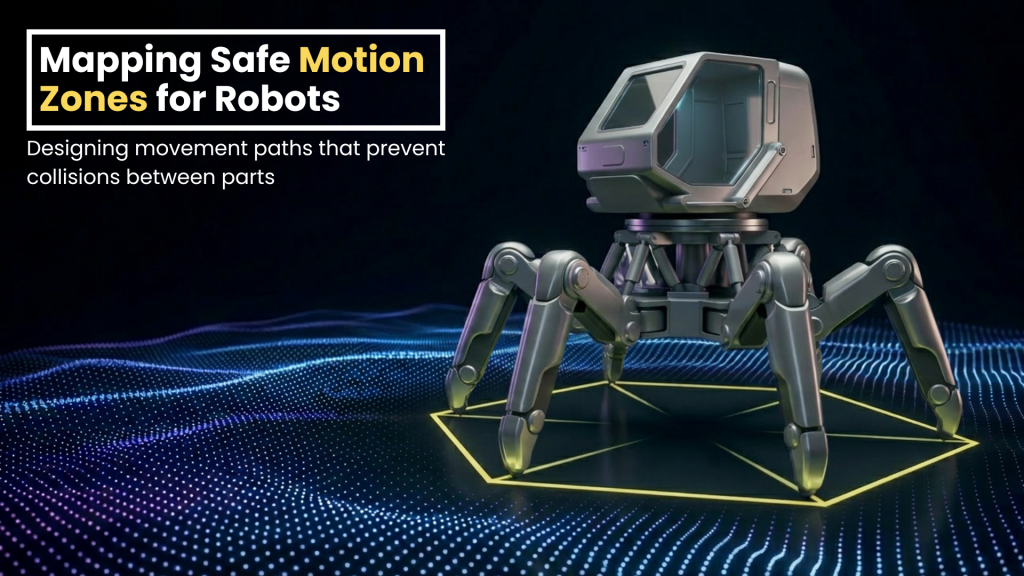
In this context, parallel robots/manipulators are gaining more attention from researchers. A parallel robot, is essentially a mechanism with two rigid platforms – a fixed platform attached to the ground (see Fig. 1), and a moving platform that performs the desired manipulations. Kinematic chains, or linkages connect the base to the moving platform. Simply put, parallel robots look like a table with several movable legs.
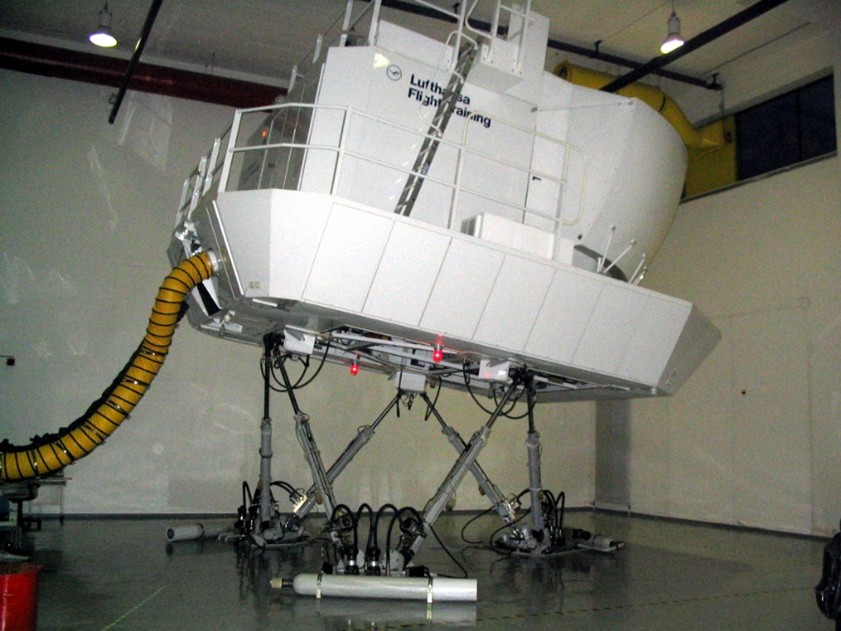
Figure 1: A flight simulator based on a Stewart platform manipulator
(Source: https://commons.wikimedia.org/wiki/File:Simulator-flight-compartment.jpeg)
Parallel robots have several advantages, such as, good rigidity, accuracy, dynamic performance, and high payload-to-self-weight ratios. They find use in flight simulation (see Fig. 1), in robotic surgeries, precision machining, etc.
However, they have drawbacks, such as greater complexities associated with their kinematic behaviour and design process, relatively smaller dimensions of workspaces, greater chances of collisions among their own links, etc.
Several attempts have been made to alleviate some or all of these drawbacks by identifying a priori (i.e., before the robot is set into the desired motion) the set of points in the workspace of respective manipulators at which these problems occur.
In this study, the authors Dr. Bibekananda Patra, Mr. Nishanth Adithya Chandramouli, and Prof. Sandipan Bandyopadhyay from the Department of Engineering Design, Indian Institute of Technology (IIT) Madras, Chennai, India, have focused on what is known as link interference in parallel robots/manipulators.
Interference is a situation where two or more parts of a robot collide or obstruct each other during motion.
The parallel manipulator studied here was the Stewart-Gough Platform Manipulator. This is one of the most famous parallel robots. It consists of six extendable legs connecting a fixed platform and a moving platform (see Fig. 1). It has six degrees of freedom (i.e., the number of independent movements a robot can achieve simultaneously), making it very agile.
Here the focus was on the computation of the region free of leg interferences inside the workspace of a semi-regular type of Stewart-Gough Platform referred to as the SRSPM. This variant was chosen for the following reasons:
1. It is, arguably, the most important spatial parallel manipulator in use, both in the industries and in academia.
2. It is one of the most difficult manipulators to analyse – hence any formulation able to do that may be logically expected to handle other problems where the kinematics is simpler, and the legs are fewer in number.
In order to study the collisions among links in parallel robots, a concept known as capsules was considered. Capsules are simple geometrical shapes used to model the robot’s legs for collision detection and motion analysis which consist of a central cylinder, which is capped at both ends by hemispheres of matching diameters.
The main contribution of this work is the identification of the largest collision-free sphere over the orientation of the workspace. The proposed computation scheme was semi-analytical in nature. For a given orientation of the moving platform, interference among any pair of legs of the manipulator was detected via tangency (refers to points in space where the legs of the robots touch each other) of the said legs. The methods used here were completely generic, and could be extended to other manipulators.

Prof. Vimalesh Muralidharan, an Assistant Professor at the School of Mechanical Sciences, Indian Institute of Technology Bhubaneswar, India, appreciated the work done by the authors with the following comments:
“This article addresses the critical challenge of link interference in the Stewart-Gough platform, the most popular and widely used parallel manipulator. The authors provide a computationally efficient framework for determining the six-dimensional collision-free workspace that involves both position and orientation components. The main contributions lie in the exact analytical formulations, geometric insights, and efficient computational schemes, all of which render the problem solvable. This work beautifully demonstrates that the underlying spatial problem can be broken down into elementary planar ones – specifically, point-to-point and point-to-line distance computations. The proposed method is generic and can potentially be applied to other parallel manipulator architectures.”
Article by Akshay Anantharaman
Click here for the original link to the paper