
Today, NVIDIA is the king of the graphic chip because they take into account various factors such as the manufacture, safety, efficiency, and performance of their electronics. Everything is well thought out.
One of the main factors to consider in electronics such as CPUs, GPUs, smartphones, and laptops, is the thermal management of the electronic devices. All electronic devices have heating problems, and managing the heat is very important because heating reduces performance, reduces lifespan, and overheating may even cause fires.
There are various thermal management techniques, such as the use of fans, liquid cooling systems, and heat sinks. Recently, the pulsating heat pipe (PHP) has become an emerging option among various cooling technologies because of its high thermal performance, simple structure, and ability to operate effectively under different gravitational orientations.
A pulsating heat pipe has the following components – an evaporator section attached to the heat source, a condenser section where heat is dissipated, and an optional adiabatic section which lies between them.
The PHP has a unique design, with multiple capillary tubes/channels connected in U-turns and partially filled with a working fluid that oscillates in the form of liquid slugs and vapour plugs (liquid slugs and vapour plugs are alternating fluid regions that enable heat transfer) transferring heat between evaporator and condenser sections, leveraging phase change phenomena for efficient heat transfer.
In this study, the authors have considered a flat plate pulsating heat pipe (FPPHP) because it is more suitable for cooling electronic components as it has appropriate thermal contact and lesser contact resistance with flat heat source surfaces. It can handle high thermal loads, making it an attractive solution for cooling electronic housings, which is crucial for the performance and longevity of modern electronics.
Most of the studies on flat plate pulsating heat pipes focus on the evaporator and the condenser being on the same side, parallel to each other, and the heat dissipation from the condenser side occurs by circulating cooled water. Owing to the size constraints and the growing demand for compact electronic housing, the challenges for thermal management have been ever-increasing.
In many commercial electronic components and data centers, the space to accommodate a condenser on the same side of heat input is not readily available. Therefore, in this study, the authors have considered an antiparallel arrangement. The condenser is placed on the opposite face to the heat input. But heat dissipation from the condenser of FPPHP by circulating cooled water is energy-intensive and not practically feasible.
One of the objectives of this study is to investigate the thermal performance of an FPPHP, where the evaporator and the condenser are arranged in a novel antiparallel manner, facing opposite each other.
The other objective involves considering two configurations of the FPPHP as given below:
Configuration 1: the design has a silicon gasket with low thermal conductivity between the FPPHP and cover plates.
Configuration 2: the gasket is replaced by O-rings to avoid any crossflow of the working fluid between the mini-channels.
The exploded views and schematics of the configurations are shown below.
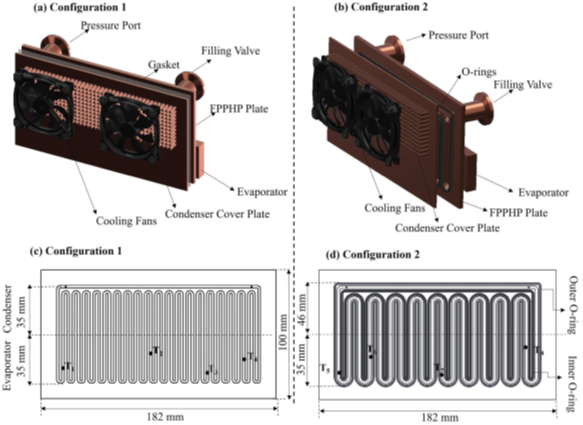
Figure 1.
Exploded views ((a) and (b)) and schematic ((c) and (d)) of the front of the FPPHP configurations studied. (a) and (c) configuration 1 and (b) and (d) configuration 2.
Although gaskets and O-rings block heat transfer because of their low thermal conductivity, they are necessary to tightly seal the FPPHP plate with the cover plate to stop ambient air leakage and stop the crossflow of the working fluid between lateral channels for better pulsation.
To conclude, the thermal performance of an FPPHP can be improved by increasing the fin length of the condenser cover plate. However, the increasing air flow resistance dominates after a certain limit, and the thermal performance deteriorates.
When the overall device performance is considered, Configuration 2 (O-rings) outperforms Configuration 1 (gasket). The overall thermal resistance is lesser in Configuration 2 by 16% over Configuration 1at higher heat inputs. Therefore, for antiparallel FPPHP arrangements, this study recommends using a flat plate pulsating heat pipe with an O-rings design instead of the conventional design with gaskets.
This study also proves that an aluminum FPPHP has a lesser thermal resistance of 20% over copper FPPHP, and is hence more suitable for commercial FPPHP production.

The following are the authors of this paper:
- Mr. Davis T. Vempeny from the Department of Mechanical Engineering, Indian Institute of Technology (IIT) Madras, Chennai, India.
- Dr. Laxman Kumar Malla from the Department of Mechanical Engineering, Sri Sivasubramaniya Nadar College of Engineering, Chennai, India.
- Mr. Hemanth Dileep from the Department of Mechanical Engineering, IIT Madras, Chennai, India.
- Dr. Pallab Sinha Mahapatra from the Department of Mechanical Engineering, IIT Madras, Chennai, India.
- Dr. Pankaj Srivastava from Instruments Research & Development Establishment, Dehradun, India.
- Prof. Arvind Pattamatta from the Department of Mechanical Engineering, IIT Madras, Chennai, India.
Dr. Srikanth Rangarajan, an Assistant Professor at the School of System Science and Industrial Engineering, who is also the Chief Technologist Officer (Thermal) at the Center for Energy-Smart Electronic Systems (ES2), at Binghamton University, State University of New York, United States, acknowledged the significance of the work done by the authors with the following comments: “I have gone through the paper by Dr. Arvind Pattamatta and his team, and it is a timely and highly relevant piece of work. This study represents significant progress in advancing pulsating heat pipe technologies, particularly through its innovative antiparallel flat plate configuration. Technology innovation aimed at reducing thermal resistance is critical for the next generation of electronics, which increasingly involve multiple devices and localized hotspots, and the approach proposed in this paper is especially significant in that context. I look forward to seeing future work from Dr. Arvind’s lab and how this line of research continues to evolve.”
Article by Akshay Anantharaman
Click here for the original link to the paper