The Teenage Mutant Ninja Turtles may be depicted as having a really nice life living in the sewers. But in reality, it’s not so sweet.
In 2022, in Sub-Saharan Africa, only 7% of the population had access to centralised sewage systems linked to wastewater treatment plants. In central and southern Asia, it was only 15% of the population.
By 2050, 22% of the world’s projected population will be contributed by Sub-Saharan Africa, and 27% of the world population will be contributed by central and southern Asia. There is therefore an urgent need to bring about sustainable sewer systems to mitigate health risks linked to inadequate and inappropriate sanitation facilities.
Developed nations such as the US and Germany invest a lot of money for sewer infrastructure. But there is a need for better understanding of sewer infrastructure before effective repair and rehabilitation can take place.
Concrete sewers are typically made with Portland Cement (PC) concrete. Portland Cement is commonly used for sewer and many other constructions because it sets and hardens under water, has high compressive strength, and good durability. But the use of this cement in sewers can lead to deterioration caused by acid attack.
Biogenic acid attack is a type of deterioration caused by acids that are produced by living organisms such as bacteria and fungi. 60% of sewer infrastructure failures are attributed to the severe deterioration of concrete sewer pipes due to the corrosive impact of biogenic acids.
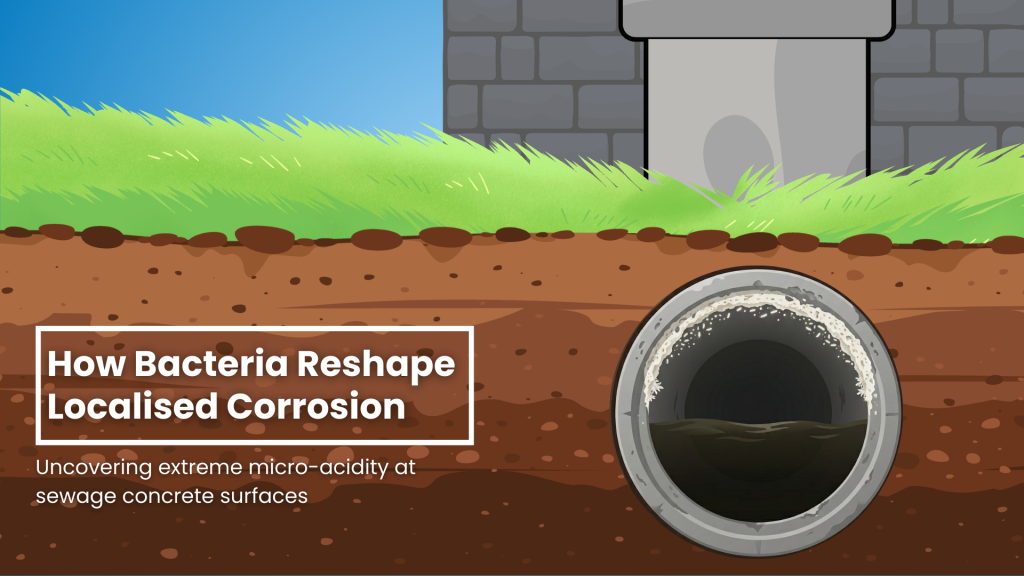
How does this happen? Sulphur-Oxidising Bacteria (SOB) react with the unsubmerged concrete sewer surface. Sulphate-Reducing Bacteria (SRB) reside in the submerged slime layer, which is the layer between wastewater and the submerged concrete surface. This produces hydrogen sulphide (H2S) gas which is released into the sewer atmosphere, creating an environment conducive for sulphur-oxidising bacteria to oxidise hydrogen sulphide gas to sulphuric acid, which then corrodes the unsubmerged concrete sewer surfaces.
One factor that needs to be taken into consideration is called the pH. pH is a measure of the acidity or basicity of a solution.
If pH is less than 7: it is Acidic (like lemon juice)
If pH is equal to 7: it is Neutral (like water)
If pH is greater than 7: it is Basic (like soap solution)
The pH of Portland Cement is between 12.5 and 13 due to its hydrated phases, such as portlandite, calcium silica hydrates (C-S-H), and calcium aluminate hydrates. Acidic conditions are created by H2S oxidation. Portlandite and carbonates dissolve, and C-S-H decalcifies to form a soft white cottage cheese-like layer of corrosion products. The corrosion products include gypsum, ettringite, and amorphous silica.
The problem that the researchers of this study had was that gypsum and amorphous silica, the products of acid attack, tend to form at very low pH values, typically ~1, which is highly acidic. But measurements of pH in ‘real’ sewers gave values closer to 4, where gypsum should not develop. The researchers therefore hypothesised, that the actual pH of the attacking acid in sewers should be as low as 1 to produce a deteriorated zone with significant amounts of gypsum. However, this pH is difficult to measure, because, on the concrete substrate, it is rapidly neutralised by alkaline species.
Therefore, in this study, the authors Dr. Alice Titus Bakera and Prof. Mark Alexander from the Department of Civil Engineering, University of Cape Town, Rondebosch, South Africa (Dr. Alice Titus Bakera is also affiliated with the Department of Structural and Construction Engineering, University of Dar es Salaam, Dar es Salaam, Tanzania), Dr. Tom Damion and Prof. Piyush Chaunsali from the Department of Civil Engineering, Indian Institute of Technology (IIT) Madras, Chennai, India, have conducted a unique study where laboratory titration tests, HYTEC modelling (HYdrodynamic TECHnochemistry – a geochemical reactive transport modelling code developed at Mines-ParisTech to simulate advection, diffusion, dispersion, and gas-phase transport coupled with chemical reactions through numerically solved mass balance equations) – and field observations have been combined to advance understanding of biogenic sulphuric acid corrosion.
The researchers’ hypothesis was validated in this study. It was confirmed that sulphuric acid produced by sulphur-oxidising bacteria in live sewers had a pH of around 1, leading to gypsum formation.
The significance of this study lies in bridging laboratory, modelling, and field observations to advance understanding of biogenic sulphuric acid corrosion. The insights of this study improve the accuracy of durability predictions and support the development of effective mitigation strategies for concrete sewer infrastructure. This study provides further insights into the nature of the biogenic acid in sewers. Clearly, this is a subject that requires further investigation.

Ass. Prof. Dr.rer.nat Cyrill Vallazza-Grengg, who is Head of the Christian Doppler Laboratory for waste-based geopolymer construction materials (GECCO2), at Graz University of Technology, Institute of Applied Geosciences, Graz, Austria, acknowledged the importance of the findings of this research with the following comments: “Despite being recognised for more than 120 years, biogenic acid corrosion remains one of the most consequential forms of deterioration affecting concrete in sewage transport and treatment infrastructure. A central challenge has been understanding how different levels of chemical aggressiveness influence the mechanisms of deterioration and the associated microstructural and mineralogical changes in concrete. This study, systematically links experimentally controlled sulfuric acid exposures at distinct pH levels with field observations and reactive transport modelling, revealing that the characteristic gypsum-rich corrosion layers, frequently observed in real systems can only be reproduced under highly aggressive conditions corresponding to an effective pH of approximately 1. By elucidating the pH-dependent sequence of reaction, transport, and phase transformations, these findings highlight the complexity of the corrosion process and advance a more holistic understanding of biogenic acid attack, paving the way for the design of more durable materials and mitigation strategies.”
Article by Akshay Anantharaman
Click here for the original link to the paper