You may have seen in cartoons or films, how birds interfere with the flight of an aircraft. However, it is true! Birds flying in the sky can actually affect the flight dynamics of an aircraft!
Learning from Nature, that is, birds, scientists have developed what is known as a morphed wing. A morphed wing can change its shape or other aerodynamic properties during flight.
The wing of the aircraft is morphed by using an external skin attached to the leading edge of the wing. When not in use, the external skin simply takes the shape of the wing and rests on it. When required, the external skin is deployed, but with a new shape, which is a morphed version of the top surface of the wing. In this study, aluminium sheets are used as the airfoil. In other words, the air now moves over a different wing and hence the aerodynamics also change.
Morphed wings find use in unmanned aerial vehicles (UAVs) like drones, fan blades, turbine blades and in regular and military aircrafts. They help to improve fuel efficiency, maneuverability, noise reduction, and multi-mission capability.
The wing generates lift when air flows over it. The lift depends on air speed, airfoil shape, and what is known as the angle of attack.
The angle of attack refers to the angle between the chord line (the shortest imaginary straight line joining the leading edge and trailing edge of the wing), and the direction of the oncoming airflow, also known as the relative wind.
In morphing wings, the angle of attack is not a single fixed angle. It is time-varying, local and motion-dependent which makes it different from conventional fixed wings.
The angle of attack is important because it controls lift generation, drag (an opposing force), and stall behaviour (stall refers to the loss of lift of an aircraft because the airflow separates from its surface.). As angle of attack increases, lift, drag and probability to stall increase.

Therefore, one of the main aims for researchers is to minimise the flow separation or stall of the aircraft. Flow separation refers to the phenomenon when airflow detaches from the surface of the body of the aircraft instead of smoothly following along the same path. This can cause sudden loss of lift, sharp increase in drag, unsteady forces and vibrations, turbulence in noise, and reduced control, which are all unwanted for proper flight.
Researchers don’t want the flow to separate so that the aircraft can get more mileage and improve its fuel efficiency and maneuverability, and morphing wings provide a solution.
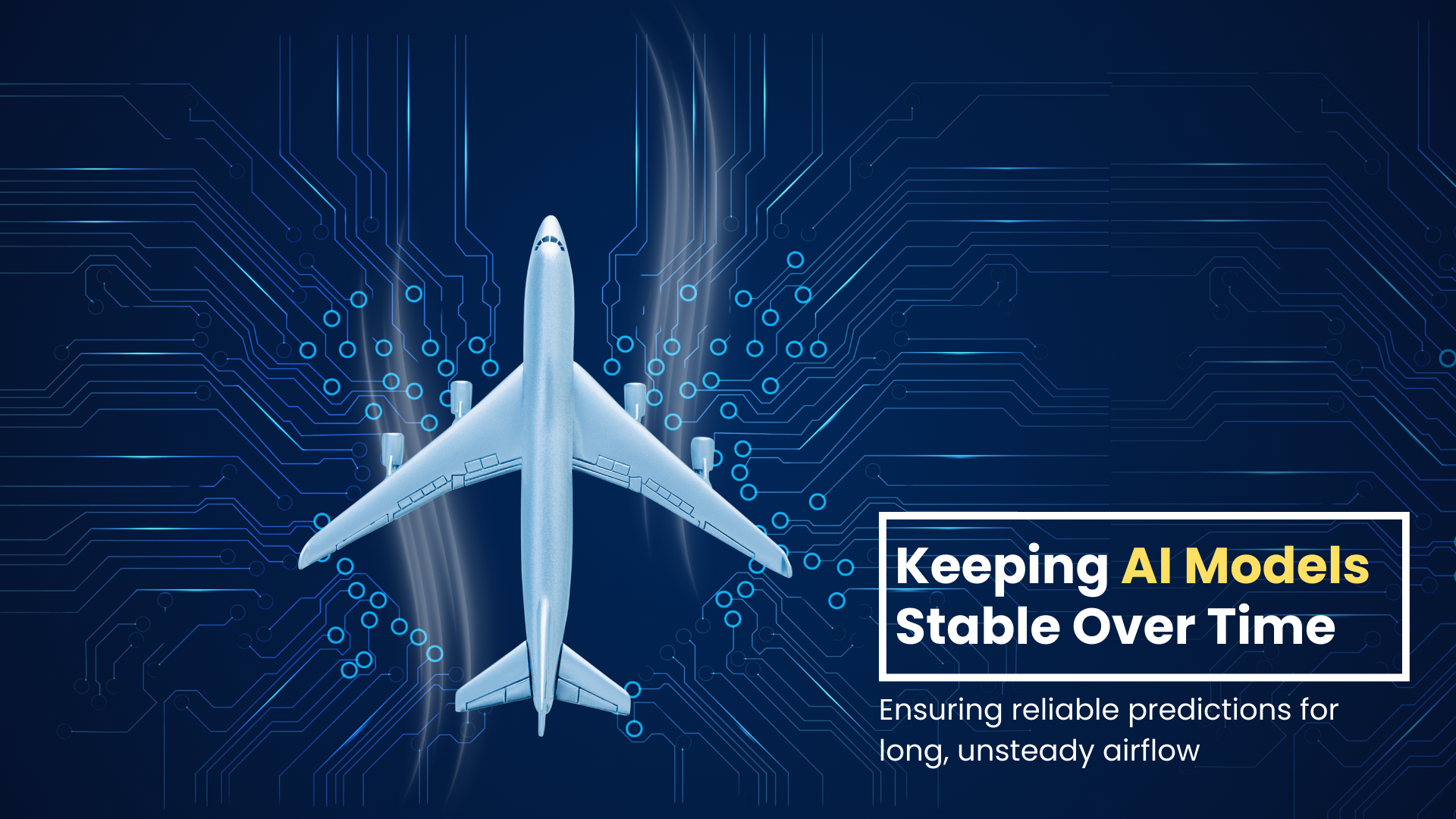
Hence, in order to evaluate the effect of such forces on the stability and design of morphing wings, a study of its unsteady aerodynamics is invaluable.
The majority of studies on active and passive methods of controlling flow separation concentrate on controlling localised laminar (laminar flow refers to gentle flow, without turbulence) boundary layer separation and enhancing stall characteristics.
A majority of the studies focus on shaping 2D airfoil sections to enhance aerodynamic performance. But this is applicable only to a particular section of the wing and is not applicable to all sections. There is limited research on the control of the flow that is separated from the entire 3D surface. Therefore, in this study, the authors Dr. Aritras Roy and Dr. Rinku Mukherjee from the Applied Mechanics and Biomedical Engineering Department, Indian Institute of Technology (IIT) Madras, Chennai, India, have tried to correctly model flow separation on a 3D lifting surface.
A morphed surface of a wing using NACA4415 airfoil section was generated numerically and implemented physically using a single external skin-like surface, attached to the leading edge that takes the shape of the top surface of the wing when not in use.
Overall, a single external skin, which is a morphed version of the camberline of the wing, attached to its leading edge was able to prevent flow separation. The aerodynamic characteristics of the baseline wing both at lower and higher angles of attack were enhanced, and functioned properly even when the flow was unsteady, without loss of operational stability.
Article by Akshay Anantharaman
Click here for the original link to the paper