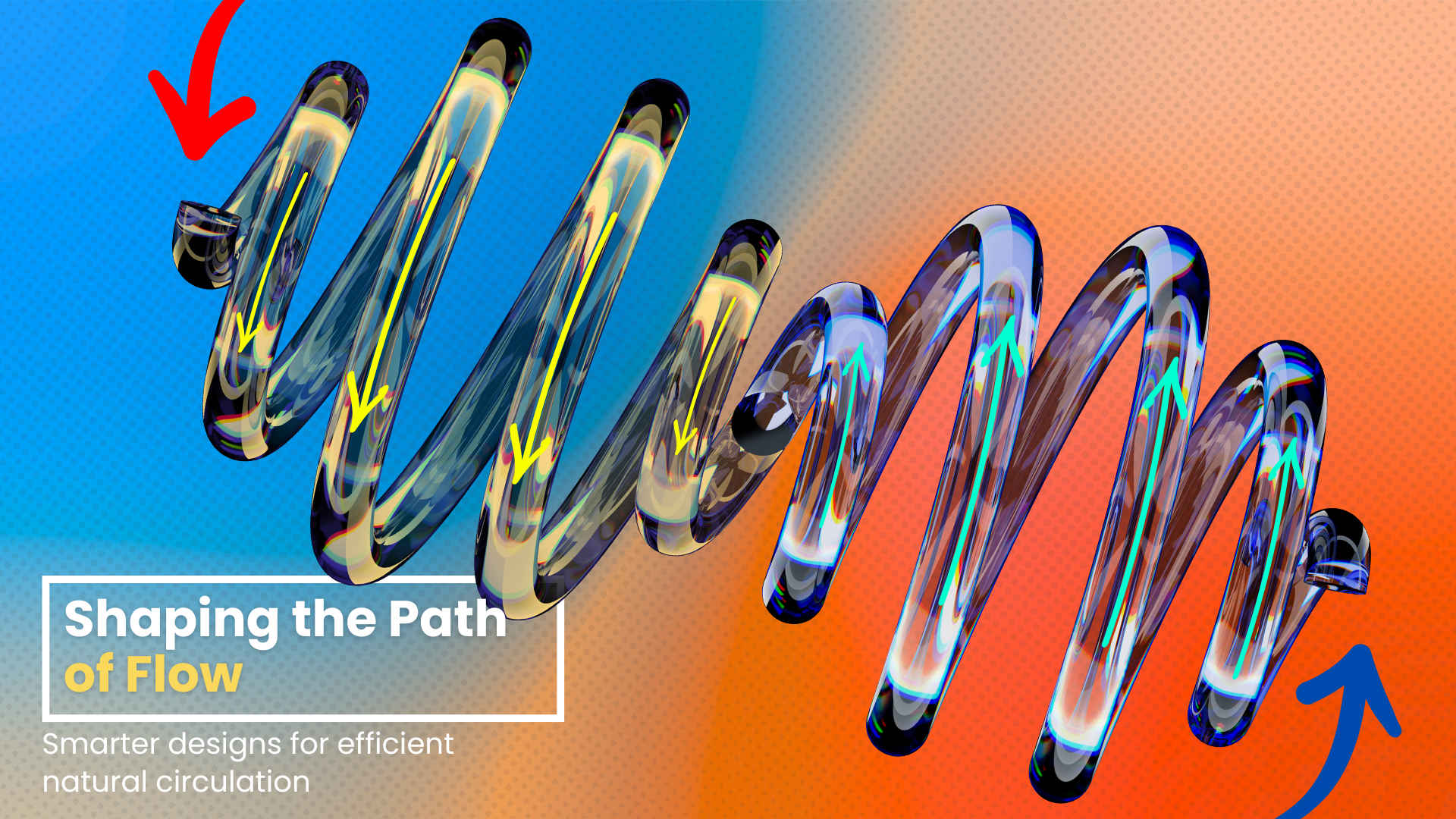
Movement without an external force? Come on! You must be kidding! But it does happen! Take the case of a natural circulation loop (NCL). In spite of no external pump or mechanical device, the fluid in the device flows simply by density differences in the fluid caused by temperature variations!
When the fluid is heated, it becomes less dense and rises. When the fluid is cooled, it becomes denser and sinks. This buoyancy effect creates a continuous flow around a closed loop.
Because of their advantages, NCLs have a wide range of applications, including solar water heaters, transformer cooling, geothermal power extraction, cooling of internal combustion engines, gas turbine blades, and nuclear reactor cores.
However, NCLs do have drawbacks. Because there is no machinery to drive the flow of the fluid, the driving force in NCLs is low. As an increased flow rate generally enhances thermal management and improves system efficiency, something has to be done to increase the speed of the flow. But very little research has been done to improve the efficiency of the loops of the NCLs.
There have been some approaches suggested to improve the efficiency of the loops, including increasing the loop height, expanding the heat transfer area, reducing flow resistance, etc. But these methods are not very effective.
In this study, the authors Mr. Karri Om Venkata Bhargava Rama Reddy and Prof. Sourav Rakshit from the Department of Mechanical Engineering, Indian Institute of Technology (IIT) Madras, Chennai, India, have, for the first time, considered what is known as topology optimization as a possible solution for increasing the efficiency of the loops.
Topology optimization is a computational design method, used to find the best possible material layout within a given design space, for a set of loads, boundary conditions, and constraints. Instead of just changing dimensions or shapes, it decides where material should exist and where it should be removed. This approach uses less materials, and improves the performance of the system.
For this study, the authors have considered a single-phase, rectangular, vertical heater vertical cooler natural circulation loop (VHVC NCL) for enhanced flow rate. A 2-D (two-dimensional) steady state, laminar incompressible flow is assumed.
But optimizing for velocity-based objective functions in natural convection problems using density-based topology optimization is particularly difficult because of the following problems – the complexity of the coupled flow and heat transfer equations, the sensitivity of velocity to small changes in the design, and the presence of artificial flow behaviour in porous regions. These challenges make the optimization process computationally intensive and more difficult to control.
Material interpolation schemes, which include RAMP (Rational Approximation Material Properties) interpolation and sigmoid interpolation, are generally used in density based topology optimization. These are mandatory interpolations. RAMP interpolation is a smooth mathematical way to connect 0 or 1, while sigmoid interpolation uses an S-shaped function to transition between 0 or 1.
It was found that fluid flow by buoyancy plays an important role in fluid dynamics. Therefore, for the first time, to the best of the authors’ knowledge, buoyancy force interpolation has been done in this study.
It was found that sigmoid interpolation combined with buoyancy force interpolation enhances the chances of the optimization algorithm to find better optimal output.
The significance of buoyancy interpolation in density-based topology optimization of natural convection-based cooling systems such as the NCL is clearly evident from this work. Future work will focus on application of buoyancy interpolation in topology optimization-based designs of various configurations of NCL other than VHVC, application of topology optimization in suppression of oscillatory flows in NCLs, and application of buoyancy interpolation for NCLs with multi-fluid and multi-phase flow.

Dr. Rajit Ranjan who is an Assistant Professor in the Department of Mechanical Engineering, Indian Institute of Technology (IIT) Jodhpur, Jodhpur District, Rajasthan, India, complimented the efforts of the authors and acknowledged the significance of the work done by them with the following comments: “This paper presents a thoughtful and well motivated application of topology optimization to single-phase natural circulation loops, addressing a problem of both fundamental and practical relevance. The proposed interpolation of the buoyancy force is particularly novel and well-motivated, offering a clear resolution to long-standing challenges associated with velocity-based objectives in natural convection optimization. The authors combine sound physical insight with careful numerical implementation, supported by systematic parametric studies over a wide range of Grashof numbers. Overall, the work makes a meaningful contribution to the field of multiphysics topology optimization and provides a strong foundation for future research in passive thermal management systems.”
Prof. Joe Alexandersen, Associate Professor and DFF Sapere Aude Research Leader, from the Institute of Mechanical and Electrical Engineering, SDU Mechanical Engineering, University of Southern Denmark, Odense, Denmark, confirmed the importance of the work done by the authors with the following comments: “The paper is very interesting and builds on an overlooked example from my own very first paper. The application of topology optimisation to circulation loops driven by natural convection has rekindled my own interest in the subject. The authors tackle the very unique issue of intermediate design variables causing increased buoyancy-driven flow, proposing and comparing multiple interpolation functions to mitigate the issue. I am excited to see what comes next.”
Article by Akshay Anantharaman
Click here for the original link to the paper