Yes, I know this is a bad joke. But please bear with me.
What are cold droppers? Or, should I ask – what are hot carriers (HCs)? To know the answer, let’s flip through our chemistry books.
Before discussing hot carriers, we need to understand plasmonic metal nanoclusters. In metals, electrons move freely through a fixed lattice of positive ions. When disturbed by light or an electric field, the electrons oscillate collectively. The coordinated motion of the electron cloud is called a plasmon. Plasmons in metallic nanoclusters can efficiently convert sunlight into chemical energy, driving important photochemical reactions.
What are nanoclusters? Nanoclusters are very small groups of atoms that are bound together and have dimensions in the nanometre range. A nanometre is one-billionth (10-9) of a metre. They exhibit unique size-dependent electronic and optical properties.
Recent studies have demonstrated the potential of nanoclusters in photoredox organic transformations, solar water oxidation, and solar hydrogen production.
Plasmons, when combined with metallic nanoclusters, drive complex photochemical reactions, including hydrogen dissociation, carbon dioxide reduction, nitrogen dissociation, and water splitting.
As plasmons decay, they produce highly energetic electrons and holes, known as hot carriers (HCs). These carriers can be transferred to the nearby acceptor through either indirect charge transfer (CT) or direct charge transfer. In direct charge transfer, the hot carriers transfer directly from the nanocluster to the unoccupied orbitals of the acceptor, making it more efficient.
This process has garnered attention because it circumvents the internal energy losses within the nanocluster, and often exhibits higher quantum efficiency in driving photochemical reactions and photovoltaic processes.
In a previous study, the authors of this paper, Ms. Khushboo Bhardwaj, Dr. Pramod K. Verma, Mr. Samir Kumar Nayak, and Prof. Sharma S. R. K. C. Yamijala, from the Department of Chemistry, Indian Institute of Technology (IIT) Madras, Chennai, India; also affiliated with the Centre for Atomistic Modelling and Materials Design, Indian Institute of Technology (IIT) Madras, Chennai, India (Prof. Sharma S. R. K. C. Yamijala is also affiliated with the Centre for Molecular Materials and Functions, Indian Institute of Technology (IIT), Madras, Chennai, India), had used plasmonic silver (Ag) and gold (Au) nanoclusters to degrade short chain per- and polyfluoroalkyl substances (PFAS). Plasmonic Ag NC in particular was highly successful in degrading PFAS.

While this proved effective, it was apparent that improving the probability would directly help in enhancing the PFAS degradation.
In this study, four different icosahedral Ag NCs, namely, Ag13, Ag55, Ag147, and Ag309 were considered. Two different PFAS molecules – perfluorooctanoic acid (PFOA) and perfluorooctanesulfonic acid (PFOS) were considered as acceptor molecules, and the direct charge transfer process in eight different NC-PFAS complexes was studied.
The main aim was to investigate the efficiency of direct hot electron transfer (DHET) from silver nanoclusters (Ag NCs) in all eight NC-PFAS complexes.
It was found that, in general, the DHET probability decreases with increasing NC size. However, the net amount of electron transfer does not show any specific size-dependent trend. Instead, it is strongly influenced by the electronic structures of the NC and PFAS.
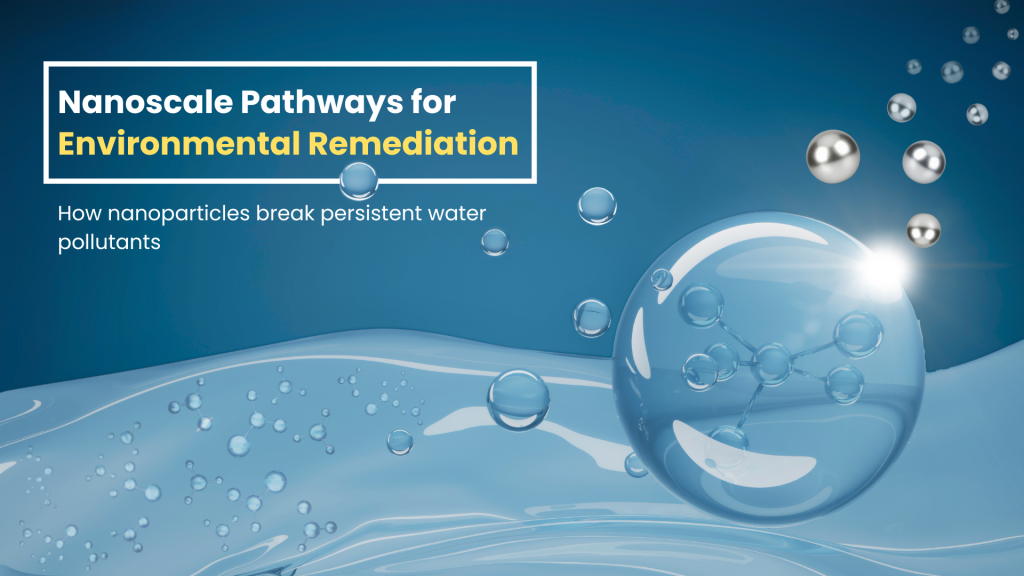
Overall, this work provides mechanistic insights into how NC size influences hot carrier dynamics in NC-PFAS complexes and offers design guidelines to enhance DHET by modifying the NC size. These findings have potential applications in environmental remediation and catalytic processes.
Prof. Nonappa Nonappa, from the Faculty of Engineering and Natural Sciences, Materials Science and Environmental Engineering, Tampere University, Tampere, Finland, acknowledged the importance of the work done by the authors with the following comments: “This study provides new and timely insights into how emerging nanomaterials, such as silver nanoclusters, can be engineered to tackle the growing environmental problem of “forever chemicals” such as PFAS. By revealing how nanocluster size controls the efficiency and stability of electron transfer required to break down these persistent chemicals, the work offers the potential to develop next-generation photocatalytic materials that could be integrated into scalable water-treatment and environmental cleanup systems.”
Article by Akshay Anantharaman
Click here for the original link to the paper